

Above is a view of the Middle Devonian strata exposed in the west wall of the River Products Inc Conklin Quarry. Unit contacts are approximate.
The field trip will begin at River Products Inc Klein Quarry in Coralville, Iowa at 9:00 A.M. on the 9th of October. Please keep in mind that this trip is on a Saturday as opposed to our usual Sunday excursions. The quarry will be operating as normal for a Saturday, so it is very important that trip participants DO NOT DRIVE ON THE OFFICE SCALE and also LEAVE A LANE FOR TRUCKS TO PASS WITHOUT CROSSING THE SCALES!
General format for GSI Field Trips is to have a short lecture on various aspects of the geology of the locality being visited.
This is a good chance to pick up information on the local geology-paleontology-minerals you could see & collect there.
Then there is a chance to search for and collect fossils & minerals that the sites contain. This is a great chance to learn some
geology and also to meet & make new friends and contacts - especially considering that 3 clubs are involved on this year's trip!
From the GSI Sept. 2010 Newsletter: "(Klein) Highlights include glacial striations as well as whalebacks in Devonian limestone, spruce logs
hundreds of thousands to nearly 2 million years old, logs from ancient trees over 300 million years old, Pennsylvanian
channels in Devonian limestone, spectacular fossils of Devonian crinoids & trilobites, and large calcite crystals.
The Conklin succession includes the upper part of the Devonian Wapsipinicon Group and parts of the Little Cedar and Coralville Formations
of the Cedar Valley Group as well as Lower and possibly Middle Pennsylvanian channel and karst fills.
Furthermore, one of the thickest, most complete sections of Pre-Illinoian Quaternary deposits in the Midwest had been exposed at Conklin.
Fossils include the branching stromatoporoid Idiostroma and the colonial coral Hexagonaria. Conklin Quarry is famous to mineral collectors for its deposits of millerite."
 A specimen of the Oncocerid nautiloid genus Acleistoceras sp. from Klein Quarry. Found by MAPS/BHGMS/CVRMS member Glen Rocca. |

A coiled nautiloid cephalopod, belonging to the same family as the modern day Nautilus Pompilius. Found by MAPS/BHGMS/CVRMS member Glen Rocca at Conklin Quarry. |
 A trilobite (Phacops rana norwoodensis) from the Lower Rapid Member of the Little Cedar Formation at Conklin Quarry. Found by MAPS/BHGMS/CVRMS member Mike Powelka. |

Above is a view of the main pit at Klein Quarry, taken from the upper bench on the west side of the quarry.
| The Blackhawk Gem & Mineral Society's Annual Gem, Mineral, & Fossil Show was held Sunday, April 25th, 2010. |
|---|
Free DHTML scripts provided by Dynamic Drive
The show was held at the Waterloo Center for the Arts, 225 Commercial St. Waterloo, Iowa 50701. The theme was 'The Lapidary Arts: Cut & Polished Nature's Beauty Revealed' - but there was much more to see & do!
| University of Iowa Museum of Natural History
announces spring series of 'Fossil Guy' presentations! |
|---|
The summaries below are only partial ones - be sure to visit the Eastern Iowa Paleontology Project's Events web page for full details on this latest lecture series!

Saturday, April 3: 'Beast Foot! Predatory Dinosaurs Large and Small' |
Get introduced to a variety of meat-eating dinosaurs during this educational program!
What were the first dinosaurs like? When and where did other carnivorous dinosaurs live?
What caused some meat-eating dinosaurs to become some of the largest predators to walk the earth,
while others remained as small as a chicken? How did the raptor dinosaurs use their sickle or 'killing'
claw on each foot to kill their prey? What can we learn about dinosaur hunting behavior from the fossil evidence?
Did some dinosaurs hunt in packs? The answers to these and many other questions can be heard at this talk!
See all sorts of cool displays as well!
|

Saturday, April 10: 'Exposing Ancient Anatomy: A Look Inside Prehistoric Beasts' |
What can we discover about the anatomy of extinct creatures from fossil evidence including bones,
footprints, eggs, skin impressions, coprolites and stomach stones? How can we use the anatomy of modern animals to
learn more about prehistoric beasts? See detailed models of Tyrannosaurus rex, Velociraptor, Triceratops, the 3-toed
horse Mesohippus, the woolly mammoth, and the giant extinct shark Megalodon that show possible reconstructions of their
skeletons, muscles, skin, and even internal organs! All these topics and many more will be discussed!
|

Saturday, April 17: 'The World of Laura the Duck-billed Dinosaur' |
See and touch fossil bones of 'Laura the Kid Dinosaur'
and learn about the world in which she lived!
Laura was a young Hypacrosaurus,
a type of crested duck-billed dinosaur that lived
75 million years ago in Montana.
Learn about what makes Hypacrosaurus special including how it chewed its food, how it grew, and how it cared for its young.
Fossils, replicas and models of duckbills and other dinosaurs that lived with Laura including tyrannosaurs, horn-faced
dinosaurs, raptor dinosaurs, armored dinosaurs, and ostrich-mimic dinosaurs will be on display. Much more will be discussed
at this presentation!
|
| The Cedar Valley Rocks & Minerals Society's Annual Gem, Mineral, & Fossil Show was held Sat & Sun March 20 & 21, 2010. |
|---|
The show was held at the Teamster's Union Hall, 5000 J Street SW, in Cedar Rapids, Iowa. It included an array of programs on Dinosaurs and other aspects of the theme.

All sorts of goodies could be seen at the show! |
Demonstrations included:
|

A little something for everyone! |
There were also silent auctions and plenty of kid friendly activities, including a fossil pit, pebble pit, and a dino dig sand pit.

Michael Sincak's 33' Tsintaosaurus display! |
There were numerous displays set up, including:
|

First Crack Geodes had these on display in the '08 show! |
| Burpee Museum Paleofest 2010 |
|---|

These youngsters had something to claw about at Paleofest in 2008! |

EIPP sponsors at Paleofest in 2006. |

An Allosaurus goes 'head to head' with an EIPP sponsor at Paleofest in 2006. |
| Thanks to all who helped the Eastern Iowa Paleontology Project
bring 'Laura the Kid Dinosaur' back to life! |
|---|
 |
 |
• Laura was a juvenile Hypacrosaurus stebingeri, a crested duck-billed dinosaur, and she lived during the Late Cretaceous Period, about 75 million years ago.
• Laura's fossilized bones were discovered in July 2004 on private land north of Dupuyer, Montana in the Two Medicine Formation. David Wolf and crew of Two Girls Fossils in Houston excavated her bones during the 2004 and 2005 dig seasons.
• The recovered skeleton is over 90% complete, with a skull that is about 50% complete. This makes Laura's fossil skeleton one of the most complete of all dinosaur skeletons!
• Laura's fossil skeleton was brought to Eastern Iowa by the EIPP sponsors. Laura may have been a male or female dinosaur. She is named after EIPP President Don Johnson's daughter.
• Laura will be 11' long and 5' high at the hips when mounted, would have been about 4 years old and weighed about 750 lbs. when alive, and had only a hint of the plate-shaped head crest of the adults.
• Laura's species is only one of a handful of dinosaur species that are known from eggs, nests, embryos, hatchlings, and all stages of development to adulthood.
The EIPP is partnering with Cycad Productions Ltd. (CPL) of Watermill, New York, to bring 'Laura the Kid Dinosaur' back to life! Roby Braun, CPL President, will be sculpting a 1:4 scale detailed life restoration of Laura using measurements from her fossil skeleton. Roby has over 30 years' experience developing exhibits featuring full-scale ancient life restorations worldwide! Roby is donating $7,000 of this $8,000 project in the form of research, design, sculpting, molding and casting fees as well as some material costs. He will also keep a journal of sketches and photographs of this project and make it available to the EIPP. The EIPP will use this journal and the Laura life restoration for educational purposes and to promote our future dinosaur exhibit. Roby and his company will become EIPP Sponsors in the 'Lifetime Donor' category. Now we are merely awaiting completion of the reconstruction by Cycad Productions! Thanks to all who participated in this effort!
MAPS decided to support this project at our meeting in December of '09, and will be listed as a donor with Laura's traveling display! To keep tabs on this incredible educational opportunity, please check out EIPP's website, or you can contact EIPP's President (who also is a member of MAPS!), Don Johnson.
Don will be at Expo 32 this year, so stop in and see some of the EIPP's wonderful displays!
'Morphological variation in Lystrosaurus', by PhD candidate Jessica Camp;
 |
and 'Phylogenetics of the Early Ordovician pliomerid trilobites
Protopliomerella, Pseudocybele, and related taxa: Unravelling the base of the cheiruroidean radiation'
by MS candidate Neo Buenger-McAdams.
 |
Trowbridge Hall is just off of Market Street (a one way going down the hill towards the river), and the IMU Parking Ramp which is adjacent to Trowbridge can be accessed off of Madison Street.
'Paleontological evidence for rapid fluctuation in the global sea level'
was presented by Dr. Ben Greenstein - Professor and Geology Dept. Chair at Cornell College.
Location: The Norton Geology Center on the Cornell College campus in Mt. Vernon, Iowa on Saturday, January 9th, 2010, at 1PM.
Dr. Greenstein's bio on the Cornell website

Above - Dr. Greenstein near Hamelin Pool, Shark Bay, Western Australia
Old man winter did not force a cancellation of the January meeting this year, and Dr. Greenstein gave a very interesting talk on Jan 9th, focusing on his research regarding the last interglacial sea level highstand which occurred approximately 130,000 years ago. This was the last time in Earth's history that sea level was higher than it is currently. Dr. Greenstein's talk was a particularly timely topic, considering the current concerns with increasing rises in mean sea level as Earth's climate warms due to man-made greenhouse gas emissions. Dr. Greenstein was gracious enough to allow MAPS to record his talk, and once there is time to edit & upload some or all of the talk, links for those interested in seeing some or all of the talk will be posted here.
'We don't just put numbers on fossils! Recent projects in the UI Paleontology Repository.'
at the regular MAPS club meeting which was held in room #125 Trowbridge Hall on the University of Iowa Campus in Iowa City.
The UI Paleontology Repository is home to over 1 million fossils from all over the world, and all geologic ages. While we spend a lot of our time cataloguing and organizing the collection (only another 880 thousand to go!), we are also involved in research, teaching and outreach. One of our goals is to develop new ways of allowing everyone to access and use our collection. Recent projects include on-line access to specimen records and images for researchers, a 'Tropical America Virtual Field School' for students, an interactive website on Iowa fossils for the public, and a new website about the Iowans who have helped build our fossil collection for everyone interested in the history of fossil collecting and the contributions of fossil enthusiasts towards paleontology research.
Tiffany Adrain, Collections Manager, gave a short talk about these projects, followed by a tour of the collection.

Above - Tiffany Adrain receives the 2008 Don Good Award at MAPS Expo 30.
To view a partial UI campus map click here.
Trowbridge Hall is just off of Market Street (a one way going down the hill towards the river), and the IMU Parking Ramp which is adjacent to Trowbridge can be accessed off of Madison Street.
The club held a well attended fall field trip, and many cool fossil & mineral specimens were discovered by club members.
Photo content from the trip will be uploaded in the coming weeks as time permits.
CLICK HERE TO VISIT THE FIELD TRIPS PAGE, and see some of the things you might find at Conklin!
 |
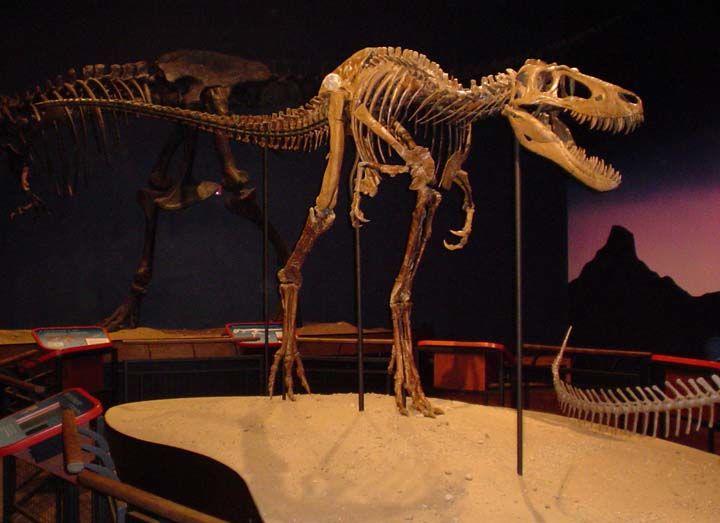 |
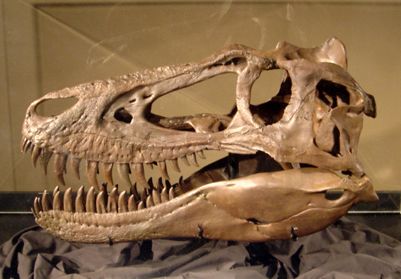
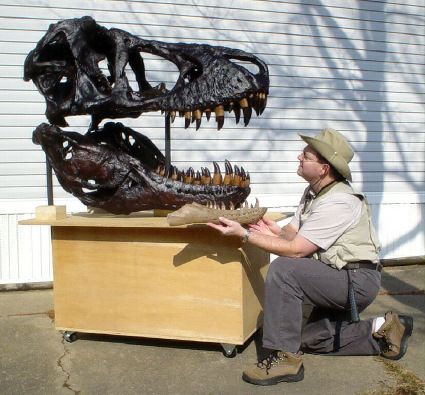
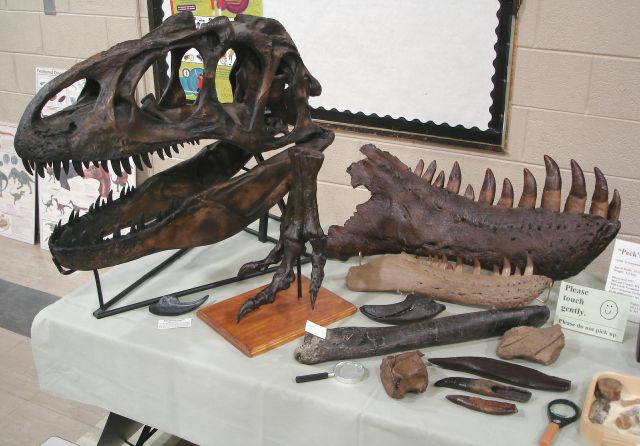
The 1st Annual Fossil Fest of Iowa was a success, with approximately 330+ people attending the event on what turned out to be one of the few nice weather days in all of October 2009. Folks were able to learn from area amateur paleontologists speaking about dinosaurs, giant ground sloths and other Iowa fossils during talks at 10am, 11am, 1pm and 2pm. At 3pm, Mike Henderson from the Burpee Museum in Rockford, IL gave his keynote talk titled 'Jurassic Jackpots: Burpee Museum's Dinosaur Discoveries from Montana & Utah.'
Ideas are being floated around and very early planning is already underway for the 2nd edition of Fossil Fest in 2010, so please bookmark the PaleoProject's website so you can keep up to date on developments: www.paleoproject.org
 |
 |

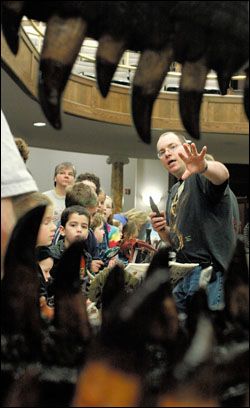 |
10:00am TALK:'Dinosaur Predator! Dinosaur Prey!' by Don Johnson - A.K.A. The Fossil Guy |
| 11:00am TALK:'Devonian Fossil Gorge - Deja vu all over again' by Jim Preslicka | 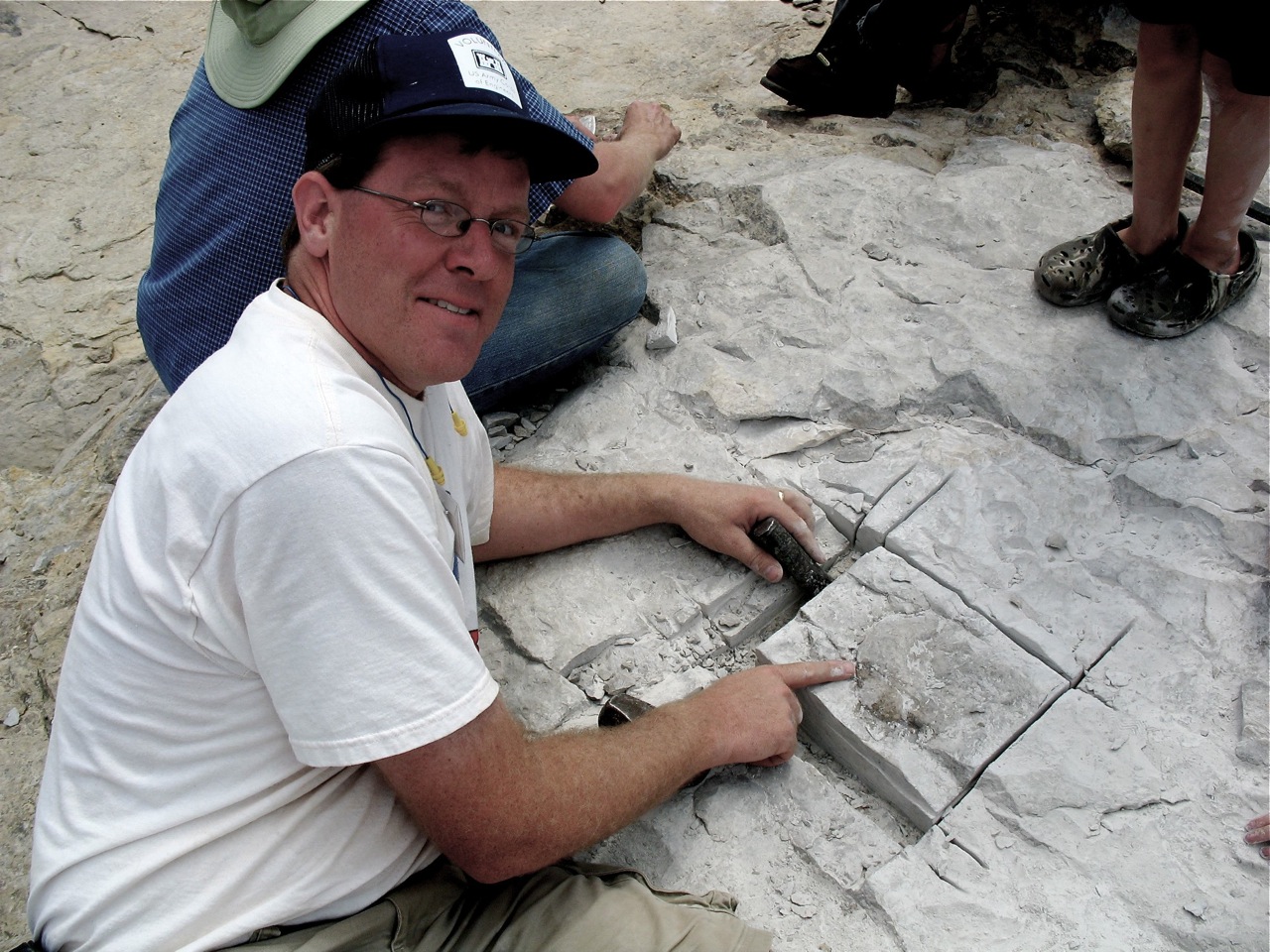 |
12:00pm LUNCH BREAK
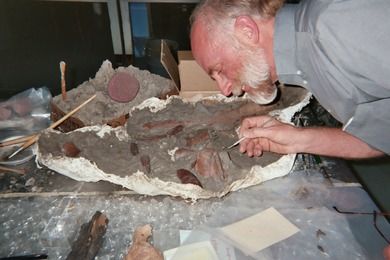 |
1:00pm TALK:'Tarkio Valley Sloth Project' by Dave Brenzel |
| 2:00pm TALK:'Track'em Down and Dig'em Up - Dinosaur Discoveries in Alberta' by Bill Desmarais |  |
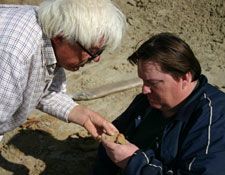 |
3:00pm KEYNOTE SPEAKER:'Jurassic Jackpot' by Mike Henderson (on the right in adjacent photo) |

Theodore Roosevelt National Park
To download a PDF file of the Fossil Fest flier click here
The 1st Annual Fossil Fest was sponsored by the Eastern Iowa Paleontology Project, the Connections Natural History Speaker Series, the Cedar Valley Rocks & Minerals Society, the Mid-America Paleontology Society, the Science Station, and the University of Iowa Museum of Natural History.
 |
 |
Above left - Stegodon, a giant ice age relative of elephants, greeted folks attending Expo 31.
Above right - Aren't you glad Charcharodon megalodon sharks are extinct?
Dr. William I Ausich of the Ohio State University gave a very informative talk titled "These are not the Crinoids your Granddaddy knew". He covered topics from the evolutionary origins of crionoids, three distinct evolutionary groups of crinoid communities, and also the beginnings of his research into possible organic molecule preservation in fossil crinoid specimens. It will be most interesting to see what the results of this research turn out to be in the coming years. Dr. Ausich also covered the coming Treatise on Invertebrate Paleontology crinoid volume revision, which will be a monumental undertaking.
Dr. Ausich then patiently took questions following his talk, answering each and every one posed to him. Dr. Ausich is also in need of some crinoid material for his organic molecule research. Several club members volunteered some of their collections - he basically needs stem material to crush up and process to search for possible organic molecules that have been protected by the calcite. The specimens will of course be destroyed by this process, but if you might have some stem material with stratigraphic control (time period, formation, etc) you are urged to contact Dr Ausich through Ohio State University.
A MAPS board meeting was held on Friday the 3rd, and it was decided to change the name of the President's Award to the Sharon Sonnleitner award, in honor of Sharon's 20 years of invaluable service to MAPS as its Tresurer. Many thanks to Sharon for her years of dedication to the club, and also for her help in the transition to the new Treasurer - I can say with certainty the new guy would be totally lost without her!A MAPS business meeting was also held on Saturday the 4th, where members discussed in polite but resolute tones the need to do more advertising/publicity for Expo in the future. In general it was agreed that the club needs to do more to raise public awareness about the show, and to increase attendance at future shows. A committee was set up to oversee Expo publicity, and a number of ideas were touched on. More emphasis will be placed on signage around Macomb, as well as reaching out to local media outlets via TV and Radio. It will take a concerted effort by the club as a whole to pull this off. Several members volunteered to hand out Expo fliers in their local areas and at other rock shows and so forth. Any member who might like to help in this fashion is urged to contact the web master (see the link on the home page near the bottom right).
Dr. Paula M Mikkelsen of the Paleontological Research Institution awarded the 2009 Katherine Palmer award to Richard E Petit during a short presentation prior to Saturday night's keynote by Dr. Ausich. The award presentation was recorded and will be available shortly on the PRI website, http://www.priweb.org .
Expo show chair Thomas Williams also announced that the focus for next year's Expo will be the Cincinnatian Stage of the Upper Ordovician. A speaker will be confirmed in the near future.
 |
Above is a panoramic view of the MAPS Expo 31 show floor.
 |
 |
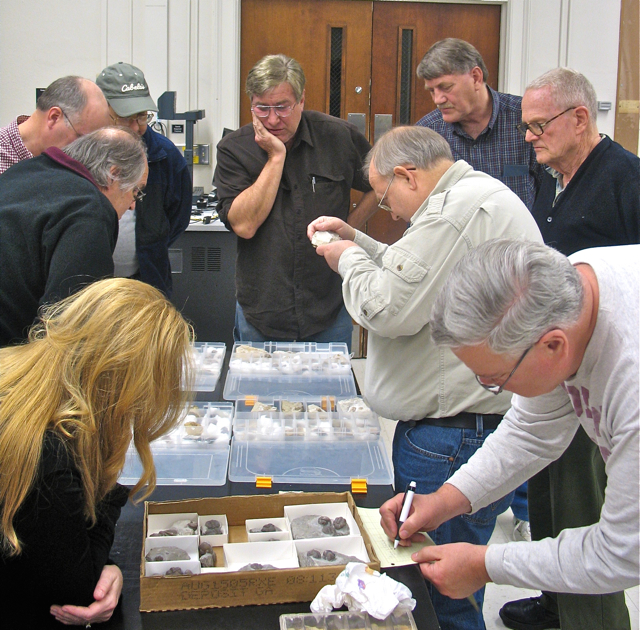
Above left - speaker Bill Hickerson shows MAPS members his trilobite collection.
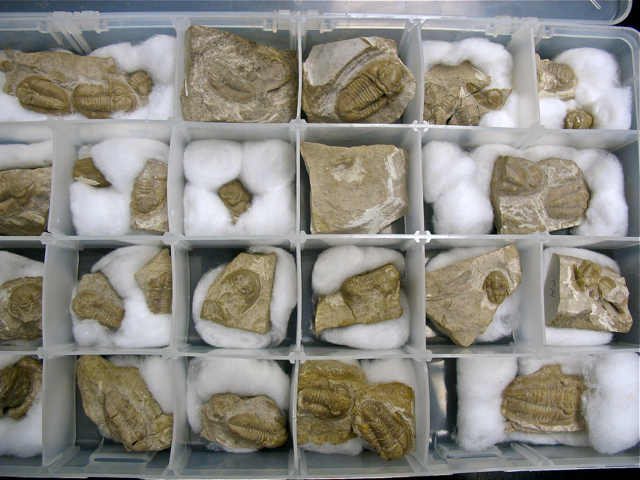
Above right - some of Mr. Hickerson's trilobites (yes, he had MANY more!).
Bill Hickerson gave a very interesting presentation on the Trilobites of the Cedar Valley Group to the club on Feb 14 at Trowbridge Hall in Iowa City. His talk included an informative slide show, with general geologic information about the local Devonian rocks, as well as about some Devonian trilobite groups. He then gave a pretty detailed discussion of some of the 32 species(!) of trilobite known from the Lower Cedar Valley Group, in the Little Cedar and Coralville Formations. Rocks from these 2 Formations should be familiar to many club members, as these are exposed at Klein and Conklin quarries, which are frequent MAPS collecting trip destinations. Many of the trilobite specimens collected by MAPS members on these trips come from the Lower Rapid Member of the Little Cedar Formation.
Bill discussed naming problems with some of the Cedar Valley genera and species, demonstrating for the club just how much work remains to be done in this area. He also covered the evolution of a few species of the well known genus Phacops in the Little Cedar Formation. Phacops iowensis is the oldest, and has 13 rows of eye facets in its compound eyes. It is replaced by P. norwoodensis which has 15 rows of eye facets. This species is in turn succeeded by P. rana with 16 or 17 rows of eye facets. This is a good example of evolution, which can be described as "change through time with cumulative modification". There must have been some selective process at work in the Phacops lineage during Cedar Valley time which favored those animals with more rows of eye facets. Did this change allow the animal to see predators earlier? Perhaps to find a mate more easily? Or maybe to find food more quickly? It is interesting to ponder.
One other point of discussion in Bill's talk was the major trilobite extinction which occurs just above the Coralville Formation. Many formerly abundant trilobite genera and species go extinct in North America at this geologic horizon, and yet similar trilobites were still common in other parts of the world at the same time. He went over several potential causes of this extinction, but none can be definitively pointed to as the cause as of yet.
After the talk a good time was had by all looking (perhaps drooling would be a better word here!) over the trilobite collection that Bill brought with him, as well as examining the Paleocene leaf collection brought in by club members Doug DeRosear and Karl Stuekerjuergen.
Click here to view more pictures taken at the club meeting .
(The business meeting took place prior to Bill's talk from 1-2 pm. In general, many of the items covered were related to the upcoming MAPS Fossil Expo XXXI the first weekend in April.)
 |
 |
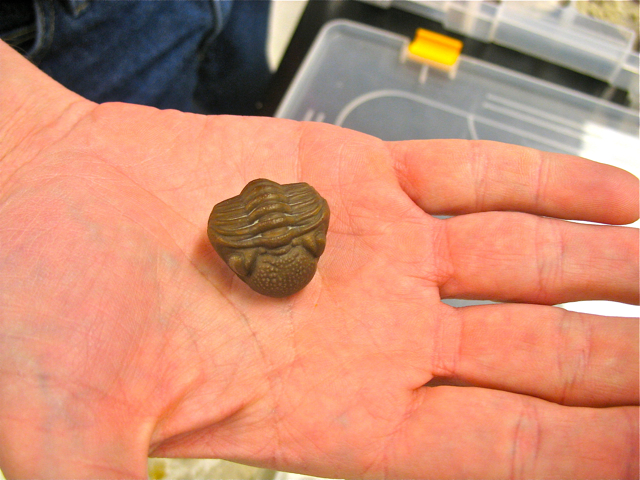
Above left - an enrolled specimen of the trilobite Phacops rana norwoodensis from the Rapid Member of the Little Cedar Formation.
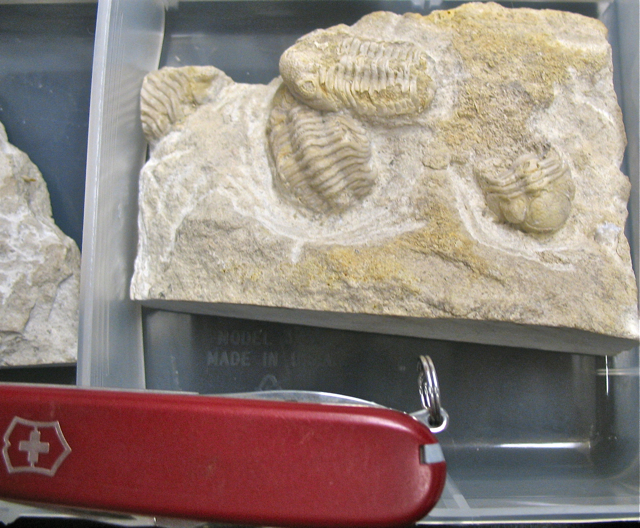
Above right - a slab of Phacopid trilobites from the Solon Member of the Little Cedar Formation.
Old man winter was unkind to us and forced first the postponement and then the cancellation of the January MAPS meeting which was to take place at Cornell on January 17th.
Was the National Fossil Expo XXXI in Western Hall on the campus of the University of Western Illinois in Macomb, Illinois.
Click here for a Map showing Western Hall
The focus this year is on crinoids and the keynote address will be given at 7pm Friday, April 3rd by Professor William I. Ausich of Ohio State University.
There will also be a regular MAPS business meeting on Saturday, April 4th at 6pm, followed by the annual awards presentations and then the Live Auction at 7pm!
Expo show hours are 8am - 5pm Friday and Saturday, and 8am - noon on Sunday. ADMISSION IS FREE!
Please click here for a printable EXPO table registration form.
EXPO XXX at Western Illinois University in Macomb, Illinois
FREE ADMISSION to the World's Largest Fossil Exhibition!
Membership is not required for your participation, except for table rental.
Full information will be available by mid-January.
BUY, SELL, SWAP & DISPLAY OF FOSSILS EXCLUSIVELY
Western Hall
Western Illinois University
Macomb, Illinois
The February MAPS(Mid-America Paleontology Society) meeting will be held in Room 125 of Trowbridge Hall at the University of Iowa on February 10. The regular business meeting will run from 1-2 p.m. followed by a program by Bill Hickerson on the fossils of the Cedar Valley Formation. (Bill is familiar to many of you for his work on the Silurian soft-bodied fauna from Eastern Iowa)
The January MAPS (Mid-America Paleontology Society) meeting will be held in Room 125 of Trowbridge Hall at the University of Iowa on January 12. The regular business meeting will run from 1:00-2:00 p.m. followed by a program by Brian Witzke of the Iowa DNR on the Pennsylvanian material in the Klein Quarry (Devonian bedrock)in Coralville
PUBLIC AUCTION Glen & Mary Hanning Estate Rocks - Fossils - Gems - Minerals For further information, contact Janice Bryant at 217-322-4096.
SATURDAY, NOVEMBER 24, 2007 AT 10:00 A.M.
Auction to be conducted at the Lowderman Auction Facility, located 2 1/2 miles west of Macomb, IL on Highway 136.
All the information for this sale is located on this website: http://www.lowderman.com/sales/11.24.07hanning/catalog.html
The November MAPS (Mid-America Paleontology Society) meeting will be held in Room 125 of Trowbridge Hall at the University of Iowa on November 10. The regular business meeting will run from 1:00-2:00 p.m. followed by a program by James Preslicka on the spectacular fossils(ammonoids, cephalopods, etc.) coming out of an eastern Iowa Devonian quarry this summer. Local collectors are being encouraged to bring some of their better specimens to the meeting for a show and tell.
The October MAPS (Mid-America Paleontology Society) meeting was held in conjunction with the fall field trip at Klein Quarry in Coralville Iowa on October 14.
March 30,31 & April 1 at Western Illinois University in
Macomb, Illinois
Theme: Dinosaurs.
Friday night's Keynote Speaker: Pete Larson
Chair: Steve Holley Co-Chair: Gil Norris
See the Expo 29 page for more information.
Location: Room 125 of Trowbridge Hall at the University of Iowa.
The regular business meeting will run from 1-2 p.m. followed by a program presented by Paul Liu and Bob McKay (research geologists from the Iowa Geological Survey) entitled "The Middle Ordivician Winneshiek Lagerstatte from the St. Peter Sandstone in northeast Iowa." This is one of the most significant fossil finds in Iowa history (from a paleontological perspective). Don't miss it!
Location: The Norton Geology Center on the Cornell College campus in Mt. Vernon, Iowa on January 20.
The regular business meeting will run from 1-2 p.m. followed by a program presented by Dr. Ben Greenstein - Professor and Geology Dept. Chair at Cornell. He has new data from his work on the coral reefs in Western Australia - as well as a story of the wreck of the Batavia which occurred on one of the islands where he worked. It is a story of murder, mutiny, intrique, survival and heroism - all integrated with fossils! Please note that this is at Cornell rather than at the University of Iowa. Speaker Link
Directions:
http://cornellcollege.edu/tours_maps/maps/static_map.shtml
The Norton Geology Bldg is basically on the corner of First St. W and Fifth
Ave. S
Mapquest gives a route turning left off of Hiway 1 on 2nd St SW and proceding to Fifth Ave. I would go a block further north on Hiway 1 to the stoplight (First St - which is the main street east and west thru town) - then turn west and proceed to Fifth Avenue. There is a small parking lot to the north of the Geology Bldg where we park.Then you have to walk up the hill to go in the front door on the south side of the building . The meeting room is right inside - the first door to the right.
From: N Dodge St & I 80 Iowa City, IA 52240 US
To: 5th Ave Sw & 1st St Nw Mount Vernon, IA 52314 US
1. Start out going NORTH on IA-1 N/N DODGE ST toward IA-1 S. Continue to
follow IA-1 N. (18.44 miles)
2. Turn LEFT onto 2ND ST SW. (0.26 miles)
3. Turn RIGHT onto 5TH AVE S. (0.07 miles)
4. End at 5th Ave Sw & 1st St Nw Mount Vernon, IA 52314 US
Total Estimated Time: 24 minutes
Total Distance: 18.77 miles
The meeting will be held in Room 125 of Trowbridge Hall at the University of Iowa on Saturday November 11. The regular business meeting will run from 1:30-2:30 p.m. followed by a program on "The progress of the sloth dig in Western Iowa" presented by Sarah Horgen, Education and Outreach Coordinator from the Museum of Natural History. There is a scheduled dig the weekend before so the program will be an up-to-date report. We have been invited to go across the street to the museum to see their sloth exhibit after the meeting. Please note that the meeting starts a half hour later than normal. Sloth Dig Link
The meeting was held in conjunction with the fall field trip at Klein Quarry in Coralville Iowa on October 15.